Wedding Budget Printable
One-Minute Summary
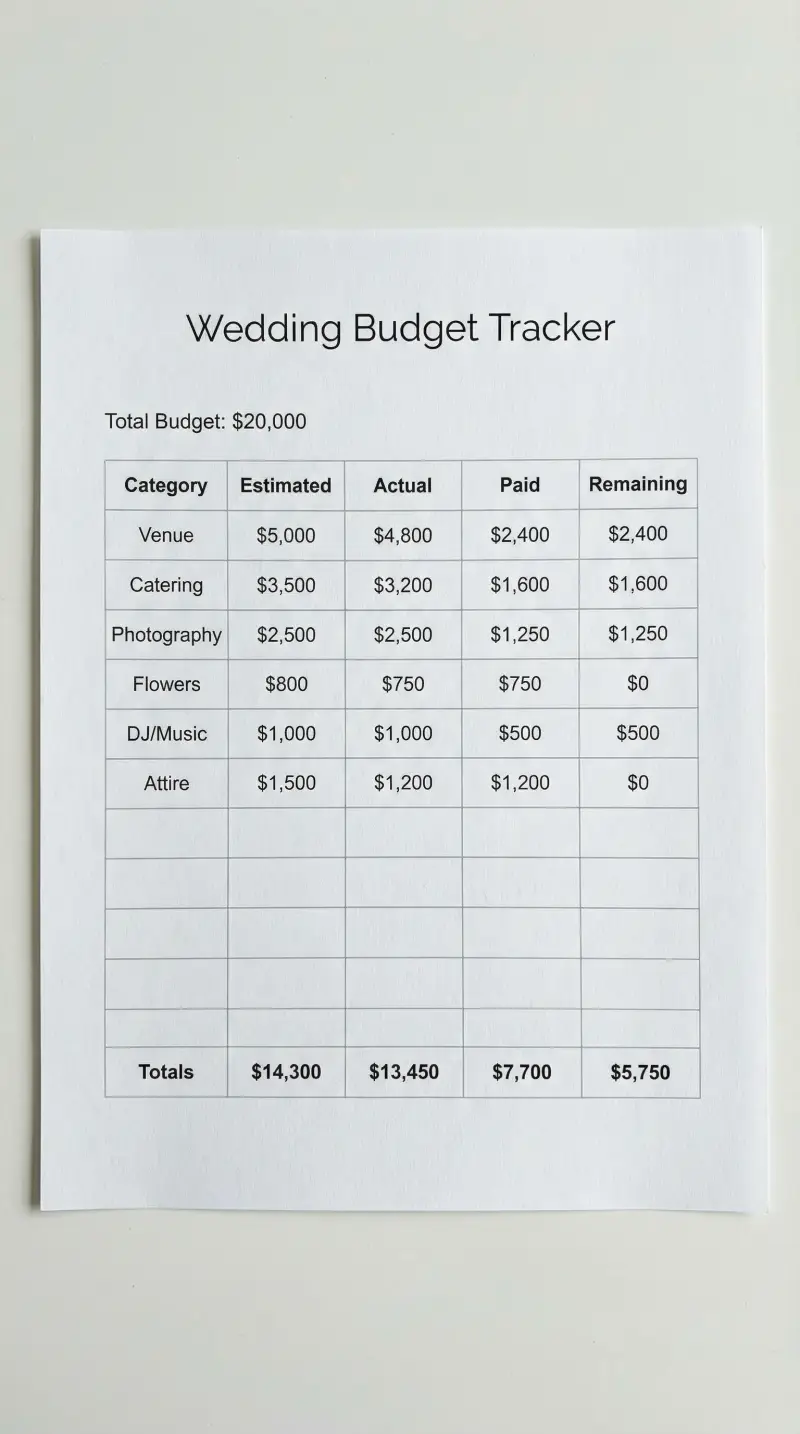
This wedding budget printable tracks your spending by category—venue, catering, photography, attire, flowers, and more. Each row has estimated cost, actual cost, and a running total. Print on U.S. Letter paper and update it as you book vendors and make deposits. Many couples use it alongside their timeline to see where the money goes and avoid overspending in one area at the expense of another.
Preview & Download
Print Settings
- Paper: U.S. Letter (8.5" × 11")
- Orientation: portrait
- Scale: 100%
- Margins: Default (0.5")
What’s on this wedding budget tracker
This wedding budget printable tracks your spending by category—venue, catering, photography, attire, flowers, and more. Each row has estimated cost, actual cost, and space for notes. A running total keeps you honest. Here’s how to use it.
The layout is designed for U.S. Letter portrait—print and keep it in your planning binder. Update it every time you book a vendor or make a payment.
How to use this budget tracker — 3 real scenarios
Scenario 1: Couple setting their first wedding budget
You’ve never planned a wedding before. Print the tracker, research averages (or use our wedding budget guide), and pencil in estimates for each category. Venue 30%, catering 25%, photography 15%—adjust based on priorities. The exercise forces trade-offs before you fall in love with a $5,000 dress. Many couples find the estimate column alone—before any spending—saves them later.
Scenario 2: Couple mid-planning trying to stay on track
You’re six months in and have booked venue, caterer, and photographer. Enter actual costs. Catering came in $800 over—trim favors, scale back florals, or skip the late-night snack. The running total shows you’re still within budget. Without the tracker, you might not notice the overage until it’s too late.
Scenario 3: Couple with family contributions
Parents are contributing. Use the tracker to show who’s paying for what—“Mom: flowers,” “Dad: rehearsal dinner.” The running total includes their contributions. When Mom offers to cover the band, adjust the music line and reallocate your own budget. Clarity prevents awkward conversations.
Example fill-out
Venue—Est. $4,500 | Actual: $4,200 (deposit $2,100 paid 2/1, balance due 5/15). Catering—Est. $8,000 | Actual: $8,400 (tasting done, deposit $2,000). Photography—Est. $2,500 | Actual: $2,500 (contract signed, paid in full). Flowers—Est. $1,800 | Actual: TBD (quote pending). Attire—Est. $1,200 | Actual: $950. Music—Est. $1,500 | Actual: $1,500. Invitations—Est. $400 | Actual: $380. Running total—$19,930 of $22,000 | $2,070 remaining.
Common mistakes (and how to fix them)
-
Not including taxes, tips, and fees. Add 15–20% buffer. Catering excludes gratuity; photography may not include prints.
-
Forgetting the rehearsal dinner. Add it as its own line—$500–$2,000 depending on size.
-
Underestimating photography. Research early and lock in a number. Good photographers book fast.
-
Ignoring the running total. Check it before signing any new contract. Approving each vendor in isolation leads to overspend.
-
Not tracking deposits vs. final payments. Use notes for “balance due 5/15”—cash flow matters when five vendors want payment the same week.
Customization tips
Adding categories: Add rows for officiant, marriage license, transportation, hair and makeup. Expand to match your spending.
Google Sheets: Add formulas for running total, conditional formatting for over-budget. Share with your partner.
Percentage column: Add % of total budget. If venue is 40% and you wanted 30%, you’ll see the drift and can reallocate.
Printing Tips
- Print on U.S. Letter (8.5" × 11") in portrait orientation
- Scale: 100% (do not use "Fit to Page")
- Margins: Default (0.5")
Next step in your wedding workflow:
Related Templates You Might Need
Most people use 2–3 of these together:
- •
- •
Helpful Guides
- •
Frequently Asked Questions
How much should I budget for each category?
A common approach: venue/catering 50–55%, photography 10–15%, flowers 8–10%, attire 8–10%, music 8–10%, invitations 3–5%, favors 2–3%. Adjust based on your priorities—if photography matters most, allocate more there and less elsewhere.
Should I include the rehearsal dinner in the budget?
Yes. Add it as its own line item. Rehearsal dinners can run $500–$2,000 depending on size. Many couples forget it and are surprised when the bill arrives.
What about hidden costs like tips and taxes?
Add 15–20% buffer to your estimates. Catering often excludes gratuity (18–20%) and tax. Photography may not include prints or albums. Build it into your numbers from the start.
How do I track deposits vs. final payments?
Use the notes column: 'Deposit $2,000 paid 2/1, balance $1,500 due 5/15.' This helps with cash flow—you'll know when multiple final payments are due and can plan accordingly.
Can I use this if my parents are contributing?
Absolutely. Add a row for each contribution or note in the category who's paying. The running total should reflect all money—yours and theirs—so you see the full picture.
What if I go over budget in one category?
Check the running total. If you're still under overall, reallocate—cut favors, scale back florals, or trim elsewhere. If you're over total, you either need to add money or cut something. The tracker makes those trade-offs visible.