Wedding Vows Worksheet
One-Minute Summary
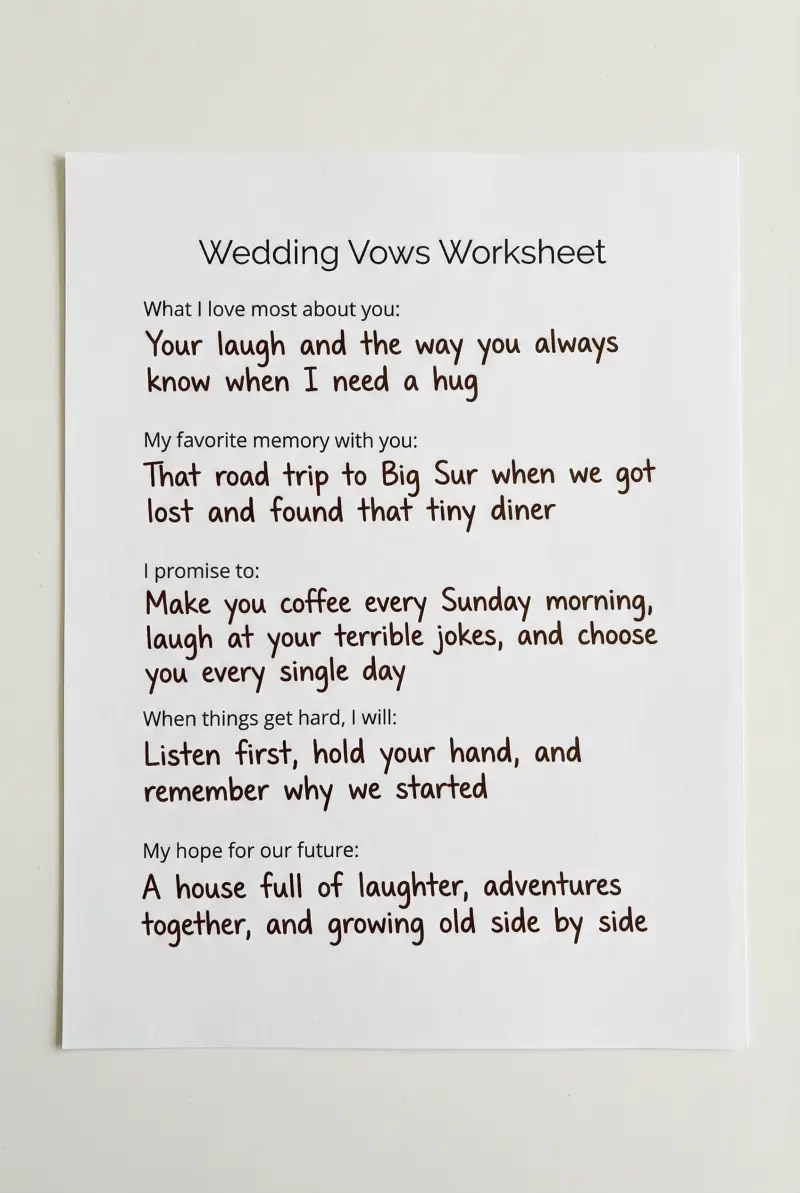
This wedding vows worksheet walks you through guided prompts—why you fell in love, what you admire, promises you want to make, and a closing. Print on U.S. Letter paper and take your time. Many couples find that the prompts unlock words they didn't know they had. Draft early, edit, and keep the worksheet for your ceremony script. Aim for 1–2 minutes when read aloud—roughly 150–250 words.
Preview & Download
Print Settings
- Paper: U.S. Letter (8.5" × 11")
- Orientation: portrait
- Scale: 100%
- Margins: Default (0.5")
What’s on this vows worksheet
This wedding vows worksheet gives you guided prompts—opening, what you admire, promises, and closing. Use it to structure your thoughts before writing. Here’s how each section works.
Print the worksheet and take your time. Draft early—4–6 weeks before the wedding—and practice reading aloud. Aim for 1–2 minutes when spoken.
How to use this vows worksheet — 2 real scenarios
Scenario 1: Couple who struggles to put feelings into words
You love your partner but find it hard to express. The prompts give you a starting point. Jot bullet points: their laugh, the way they listen, that trip to the mountains. Turn bullets into sentences. Many couples draft in 30 minutes, set it aside, and come back to edit. The structure does the heavy lifting.
Scenario 2: Couple who wants to match tone and length
You’re both writing vows and want them balanced. Fill out the worksheet separately, then share drafts. Compare length—if one has 300 words and the other 100, adjust. Agree on a rough outline: opening (30 sec), what you admire (30 sec), promises (60 sec), closing (15 sec). The worksheet gives you a common structure.
Example fill-out
Opening: “When we met, I had no idea you’d become my favorite person. It was your laugh—the way you find joy in small things—that first drew me in.” What I admire: “You’re the most steady person I know. When I’m spinning out, you ground me. You show up for my family, our friends, me—without being asked.” Promises: “I promise to choose you every day, to be your partner in adventure and quiet nights, to make you laugh when you’re stressed, to grow with you.” Closing: “That’s why I choose you, today and always. I love you.”
Common mistakes (and how to fix them)
-
Leaving vows for the week before. Start 4–6 weeks out. Draft, set aside, come back. Rushed vows feel rushed.
-
Writing a novel. Aim for 150–250 words. Edit ruthlessly. Guests want to feel the moment, not check their watches.
-
Making unkeepable promises. Promise presence, honesty, partnership—not perfection.
-
Forgetting to practice aloud. Read your vows out loud. Time yourself. Smooth the rough spots.
-
Going too private. A little humor is fine—but guests should understand the gist.
Customization tips
Matching with your partner: Agree on structure and length. Share drafts or word counts. Some couples write the middle together, keep opening and closing personal.
Incorporating tradition: Add a traditional line at the end—“With these words and this ring, I thee wed.” The worksheet covers the personal part.
Keeping a copy: Give one to your officiant. Frame your vows or print them in your album. The worksheet becomes a keepsake.
Printing Tips
- Print on U.S. Letter (8.5" × 11") in portrait orientation
- Scale: 100% (do not use "Fit to Page")
- Margins: Default (0.5")
Next step in your wedding workflow:
Related Templates You Might Need
Most people use 2–3 of these together:
- •
- •
Helpful Guides
- •
Frequently Asked Questions
How long should my vows be?
Aim for 1–2 minutes when read aloud—roughly 150–250 words. Enough to feel personal, not so long that guests drift. If you and your partner are both writing, try to match length so the vows feel balanced.
Do I have to write my own vows?
No. Traditional or repeat-after-me vows are perfectly valid. This worksheet is for couples who want personal vows. You can also mix—personal opening, traditional closing.
Should we share our vows before the ceremony?
Many couples share drafts to match tone and length—without revealing every word. Some prefer to keep them a surprise. Do what feels right. Either way, give a copy to your officiant so they have it for the ceremony.
What if I'm not a good writer?
The prompts do the work. Jot down bullet points—why you fell in love, what you admire, 3 promises. Turn bullets into sentences. You don't need perfect prose; you need honest words. The structure helps.
Can we use humor?
Yes—if it feels like you. A light moment can ease tension. But balance it with sincerity. Your guests want to feel the love, not just the laughs.