Wedding Day-of Timeline
One-Minute Summary
This wedding day-of timeline maps your wedding day hour by hour—hair and makeup, first look, ceremony, family photos, cocktail hour, reception entrance, dinner, speeches, first dance, and breakdown. Print on U.S. Letter paper and share with your vendors and wedding party. Many couples use it as the single source of truth so everyone knows when to be where. The timeline prevents gaps, overlaps, and the 'wait, when do we eat?' confusion that can derail a smooth day.
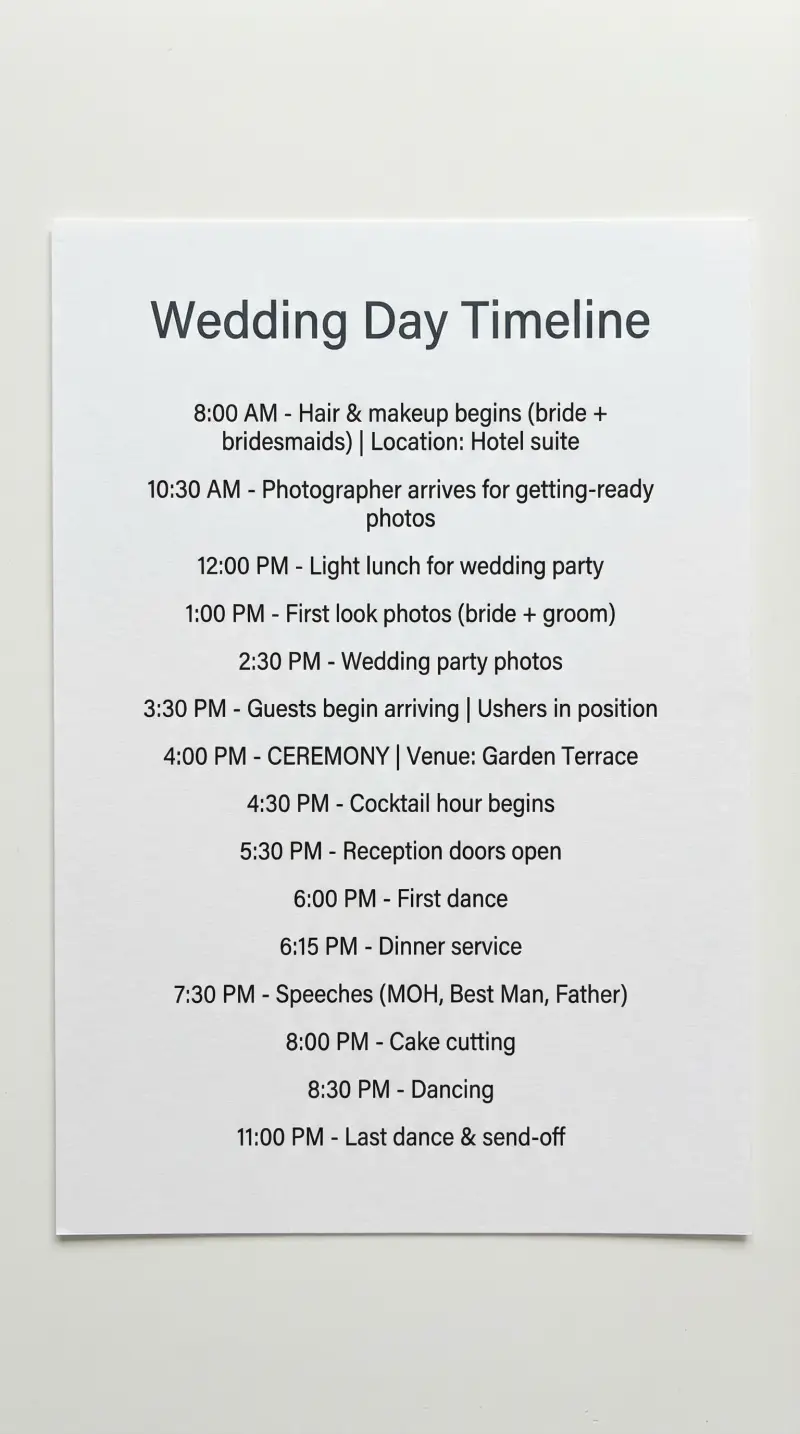
Preview & Download
Print Settings
- Paper: U.S. Letter (8.5" × 11")
- Orientation: portrait
- Scale: 100%
- Margins: Default (0.5")
What’s on this day-of timeline
This wedding day-of timeline maps your day hour by hour—hair, photos, ceremony, reception. Each block has time, activity, location, and key people. Here’s how to use it.
Print and share with vendors and wedding party. Build in buffer between major blocks. The timeline is your single source of truth for the day.
How to use this day-of timeline — 3 real scenarios
Scenario 1: Couple with a tight schedule
Your venue has a strict end time—music off by 11pm. Work backwards: last dance 10:30, cake 10:00, dinner 7:30, ceremony 4:00, first look 2:30, hair 9:00. Fill in each block and share with vendors. The timeline ensures you hit every moment without rushing. Without it, the day drifts—cocktail hour stretches, dinner starts late, and you’ve lost 30 minutes.
Scenario 2: Couple coordinating with multiple vendors
Photographer, caterer, DJ, florist, coordinator—each needs to know when to show up. Create the timeline, add vendor notes per block, and send it 2 weeks before. The photographer knows first look is 2:30, the caterer knows cocktail hour 5:00–6:00 and dinner at 6:15. One document, everyone aligned.
Scenario 3: Couple with a large wedding party
You have 8 bridesmaids and 8 groomsmen. They need to know: hair 9:00, dressed by 1:30, first look 2:00, lineup 3:45. Share the timeline in your wedding party chat. Everyone has the same info. No one shows up at 4:00 when they were needed at 2:00.
Example fill-out
9:00–10:30 Hair and makeup—Bridal suite. 10:30–11:00 Groom and groomsmen get ready. 12:30–1:30 Wedding party photos. 2:00–2:30 First look—Oak tree. 2:30–3:30 Couple portraits. 3:30–4:00 Family photos. 4:00–4:30 Ceremony—Garden Lawn. 4:30–5:30 Cocktail hour—Terrace. 5:30–5:45 Reception entrance. 6:00–7:00 Dinner. 7:00–7:30 Speeches. 7:30–8:00 First dance, parent dances. 8:00–10:30 Dancing, cake cutting 9:00. 10:45 Last song. 11:00 Venue clear.
Common mistakes (and how to fix them)
-
Not building in buffer. Add 15–30 minutes between major blocks. Hair runs over, family photos drag. Rushing creates stress.
-
Forgetting vendor setup time. Photographer may need to arrive at 1:00 for a 2:00 first look. DJ needs setup before cocktail hour. Add those to the timeline.
-
Not sharing with everyone. Send to vendors, wedding party, coordinator. A timeline no one sees is useless.
-
Scheduling dinner too late. Cocktail hour 5:00–6:00, dinner by 6:15–6:30. Hungry guests get restless.
-
Overpacking the reception. Leave room for open dancing. If every 15 minutes has a planned moment, guests never relax.
Customization tips
Working backwards: Start with venue end time. Work backwards—last dance, cake, dinner, ceremony, photos, hair.
Vendor-specific versions: Create one-pagers for photographer (photos only) or caterer (meal times). Full timeline is master; vendor versions are extracts.
Print and laminate: Give copies to coordinator, venue, photographer. Laminate to survive the day. Paper beats digital when you’re in the moment.
Printing Tips
- Print on U.S. Letter (8.5" × 11") in portrait orientation
- Scale: 100% (do not use "Fit to Page")
- Margins: Default (0.5")
Next step in your wedding workflow:
Related Templates You Might Need
Most people use 2–3 of these together:
- •
- •
Frequently Asked Questions
When should I create the day-of timeline?
2–3 weeks before the wedding, once you have your venue timing, catering schedule, and any vendor requirements locked in. Share it with everyone so they have time to review and ask questions.
How do I share the timeline with vendors?
Email a PDF to each vendor. Many will want to confirm their arrival and setup times. Your coordinator can distribute it, or you can send it directly. Include vendor notes per time block so they know when they're needed.
What if something runs late?
Build in buffer—15–30 minutes between major blocks. If hair runs over, you have a cushion before first look. Your coordinator can also help adjust on the fly. The timeline is a guide, not a straitjacket.
Should the wedding party have a copy?
Yes. Share it in your wedding party chat or print copies. They need to know when to arrive for hair, when to be dressed for photos, when to line up for the ceremony. Fewer repeat questions, less chaos.
How long should cocktail hour be?
Typically 1 hour. Long enough for guests to mingle and have a drink, short enough that they don't get restless. If you're doing formal photos during cocktail hour, 1 hour is usually enough. Stretch to 1.5 hours only if you have a lot of photos or a late-running ceremony.
When should dinner start?
Soon after cocktail hour—within 15–20 minutes of guests moving to the reception space. If cocktail hour ends at 6:00, dinner should start by 6:15–6:30. Guests get hungry; delayed dinner leads to restlessness.