Ceremony Script Template
One-Minute Summary
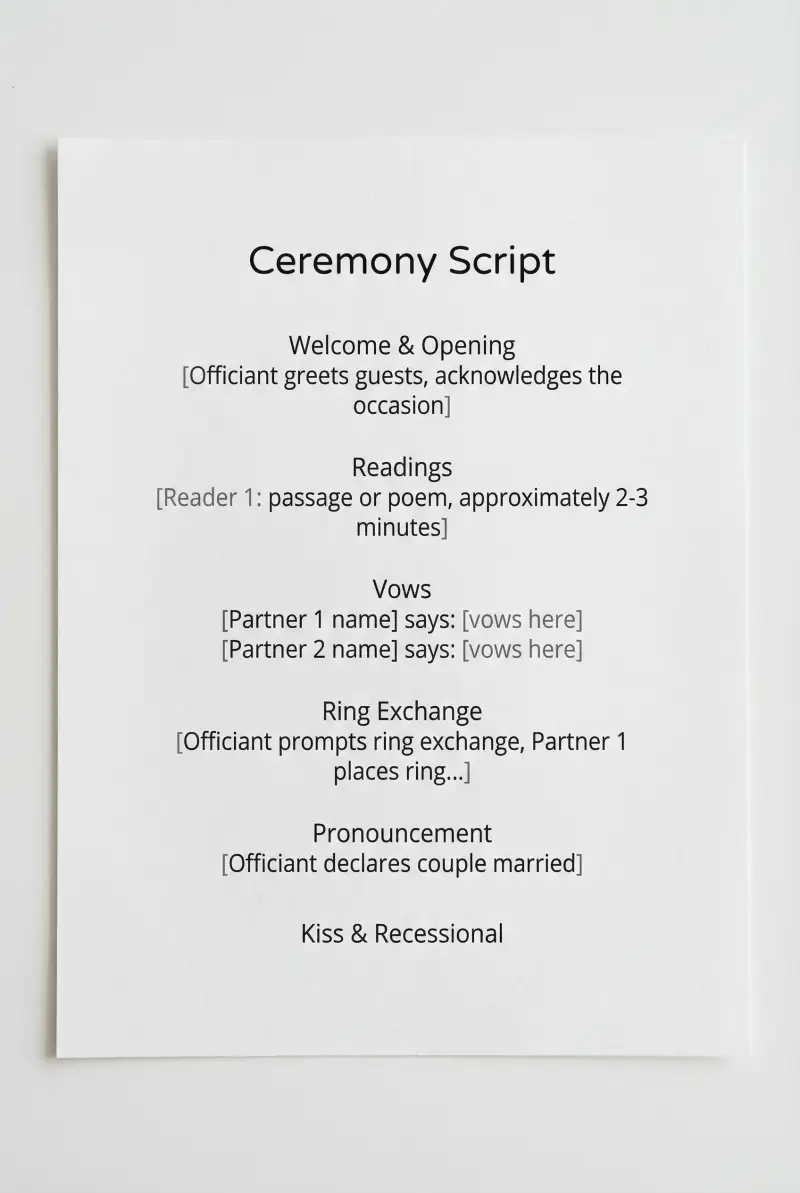
This ceremony script template gives you a structured outline to fill in—processional order, welcome and invocation, readings, vows, ring exchange, pronouncement, and recessional. Print on U.S. Letter paper and work through it with your officiant. Many couples use it to ensure nothing is forgotten and to align with their officiant on tone, length, and any religious or secular elements. The template is flexible—add your own words, remove what doesn't fit, and make it yours.
Preview & Download
Print Settings
- Paper: U.S. Letter (8.5" × 11")
- Orientation: portrait
- Scale: 100%
- Margins: Default (0.5")
What’s on this ceremony script template
This ceremony script template gives you a fill-in outline—processional, welcome, readings, vows, ring exchange, pronouncement, and recessional. Work through it with your officiant. Here’s how each section works.
The layout flows top to bottom in ceremony order. Fill in names, passages, and any custom wording. Print and share with your officiant before the rehearsal.
How to use this ceremony template — 3 real scenarios
Scenario 1: Couple writing a secular ceremony with personal touches
You want a meaningful ceremony without religious elements. Use the template: welcoming words, a reading (poem or passage from a favorite book), personal vows, ring exchange, pronouncement. Fill in who reads what. Work with your officiant on tone—warm but not stiff. The template ensures you don’t forget the recessional or thank-you to guests. Many couples find the outline reduces ceremony anxiety.
Scenario 2: Couple incorporating religious elements
You want scripture, prayer, or religious language. The template has sections for invocation, readings, and vows. Fill in “Opening prayer: Psalm 121” or “Unity candle: mothers light side candles.” Your officiant may have a standard script; the template helps you customize—add a reading, change vow wording. Share the filled template before the rehearsal.
Scenario 3: Couple with a friend or family officiant
A friend or family member is officiating. The template gives them a roadmap. Fill it out together—processional order, who does readings, vow format. The officiant uses it as their cue sheet. Having everything written reduces their nerves and ensures nothing is skipped. Provide a printed copy at the rehearsal for practice.
Example fill-out
Processional: Groom’s grandparents → Bride’s mother (escorted by son) → Groomsmen → Bridesmaids → Flower child (niece Emma) → Ring bearer (nephew Jake) → Bride with father. Welcome: officiant—welcome guests, brief secular invocation. Reading 1: Sister Maria—1 Cor 13:4–7. Reading 2: Friend Tom—custom poem. Vows: personal (see vows worksheet). Ring exchange: traditional repeat-after-me. Pronouncement: “I now pronounce you husband and wife.” Recessional: Bride & Groom → Wedding party → Family → Guests.
Common mistakes (and how to fix them)
-
Not sharing the script with the officiant until rehearsal. Send it at least 2 weeks before. They need time to review and practice.
-
Forgetting to assign readers. Write the name and passage on the template. Confirm with them beforehand.
-
Making the ceremony too long. Aim for 15–20 minutes. Multiple readings and rituals add up. Edit with the officiant.
-
Not rehearsing processional and recessional. Walk through the order at rehearsal. Who escorts whom? Who goes first?
-
Leaving vows for the last minute. Personal vows take time. Use the vows worksheet, draft early, attach to the script.
Customization tips
Adding rituals: Sand ceremony, handfasting, wine ceremony—add a section for each. Describe the ritual, who performs it, props needed.
Timing: Note rough timings (welcome 2 min, reading 1 min, vows 3 min each). Helps you stay within 15–20 minutes.
Bilingual ceremonies: Note which parts are bilingual and who speaks what. The template accommodates mixed-language ceremonies.
Printing Tips
- Print on U.S. Letter (8.5" × 11") in portrait orientation
- Scale: 100% (do not use "Fit to Page")
- Margins: Default (0.5")
Next step in your wedding workflow:
Related Templates You Might Need
Most people use 2–3 of these together:
- •
- •
Helpful Guides
- •
Frequently Asked Questions
How long should the ceremony be?
A common approach is 15–20 minutes. Welcome and invocation 2–3 min, readings 2–4 min, vows 4–6 min, ring exchange 2 min, pronouncement 1 min. Add time for rituals (unity candle, etc.). Over 25 minutes and guests may get restless.
Do I need to write my own vows?
No. Many couples use traditional or repeat-after-me vows. If you want personal vows, use our vows worksheet and attach it to the ceremony script. Give the officiant a copy so they know the format.
How do I share the script with my officiant?
Send the filled template by email at least 2 weeks before the wedding. Include the processional order, readings (and who reads them), and vow format. They may have edits or suggestions. Bring a printed copy to the rehearsal.
What if we want a mix of religious and secular?
The template is flexible. Use the invocation for a brief prayer, add a scripture reading, then use secular or personal vows. Or open with a moment of reflection and include one religious reading. Fill in what fits—the structure accommodates both.
Who typically does the readings?
Friends or family members—siblings, close friends, parents. Assign one or two people and give them the passage ahead of time. They may want to practice. Include their names and the passage on the ceremony script.
Should we rehearse the processional?
Yes. Walk through the processional and recessional at your rehearsal. The script has the order—but people need to practice it. Who escorts whom? Who goes first? Rehearsal catches the confusion.