Debt Payoff Tracker Printable
One-Minute Summary
This printable debt payoff tracker helps you list each debt — balance, minimum payment, your payment, and remaining amount. Log payments as you make them. Watch balances drop. Print on U.S. Letter paper. This is an organizational tool to track progress. It is not financial advice. There are different approaches to paying off debt (e.g., snowball vs. avalanche); research what works for you.
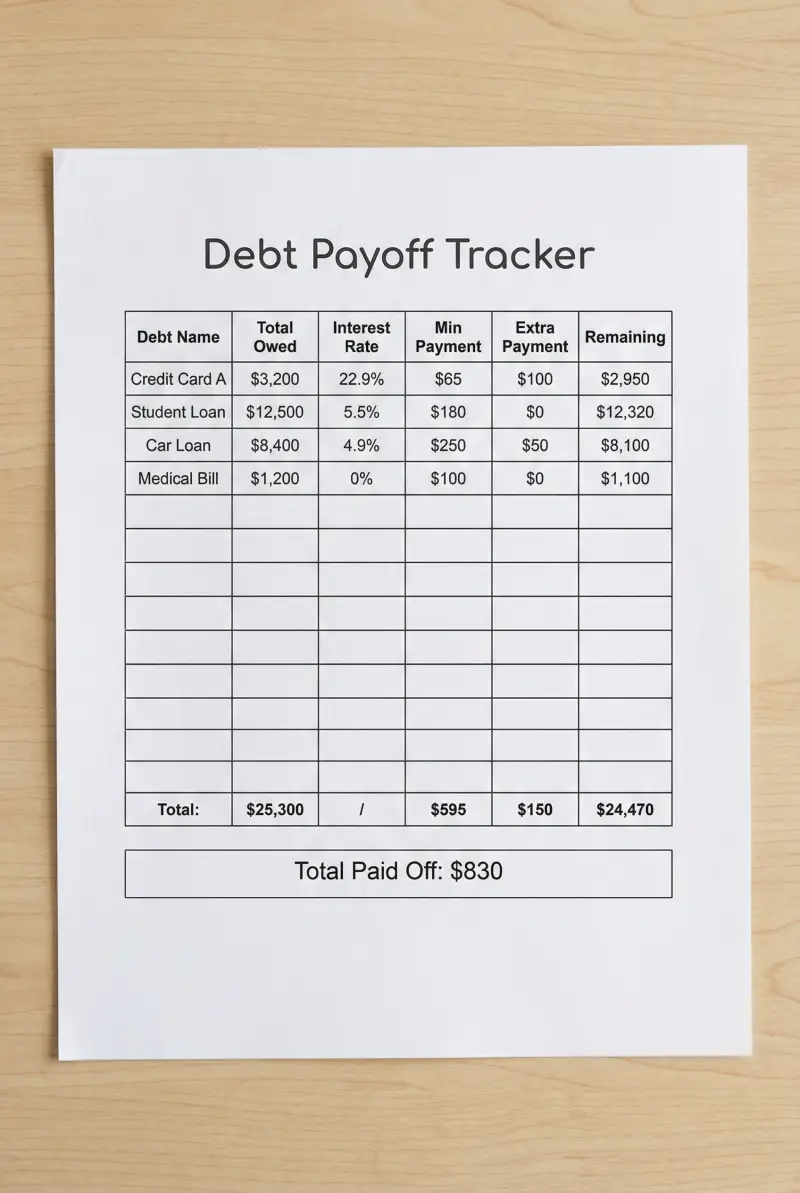
Preview & Download
Print Settings
- Paper: U.S. Letter (8.5" × 11")
- Orientation: portrait
- Scale: 100%
- Margins: Default (0.5")
- 💡 Update monthly. Log every payment. See progress.
What’s on this debt payoff tracker
List each debt — balance, minimum payment, your payment. Log payments. Watch balances drop. This is an organizational tool — it is not financial advice. There are different approaches to paying off debt; research what works for you.
How to use this tracker — 3 real scenarios
Scenario 1: Tracking credit card payoff
You list both cards, pay extra on the smaller one, log each payment. Balance drops. When one is done, you roll that payment to the other. The tracker shows progress when motivation dips.
Scenario 2: Managing multiple debts
Car, student loan, credit card. You list all three. You see the total. You allocate extra to one debt. You update monthly. The tracker keeps you focused.
Scenario 3: Staying motivated
Debt payoff is a marathon. You check off milestones. Every $500 paid feels like progress. The tracker makes the abstract concrete.
Example fill-out
Credit Card A: $1,200 → $1,050. Credit Card B: $800, min only. Next month roll extra to Card B when A is done.
Common mistakes (and how to fix them)
- Only tracking one debt. List everything. Full picture.
- Not updating balances. Update monthly. Old numbers are useless.
- Assuming one payoff method is best. Research options. Choose what fits. Tracker records; it doesn’t prescribe.
- Forgetting to log payments. Log each one. Visual progress motivates.
- Getting discouraged. Celebrate milestones. You’re moving forward.
Customization tips
Pick a payoff approach — research what fits. Add extra when you can. Sync with Budget Planner. Celebrate milestones.
Printing Tips
- Print on U.S. Letter (8.5" × 11") in portrait orientation
- Scale: 100% (do not use "Fit to Page")
- Margins: Default (0.5")
- 💡 Update monthly. Log every payment. See progress.
Next step in your meal prep workflow:
Related Templates You Might Need
Most people use 2–3 of these together:
- •
- •
Helpful Guides
- •
- •
Frequently Asked Questions
Should I pay smallest or highest interest first?
Different approaches exist. Some people pay the smallest balance first for quick wins. Others pay the highest interest to minimize total cost. Research both. Many people find one method more motivating. Choose what fits your situation. This tracker works with either approach.
How often should I update balances?
Monthly, when you get statements. Or after each payment if you want real-time tracking. Consistency matters more than frequency.
What if I can only pay minimums?
Track anyway. You'll see the full picture. When you can add extra — raises, tax refund, cutting something — you'll know where to put it. The tracker keeps you aware.
Should I include mortgage or student loans?
Your choice. Some people track everything. Others focus on consumer debt (cards, personal loans). Student loans and mortgage are often long-term; include them if you want the complete picture.
What if a balance goes up (interest, new charges)?
Update with the new balance. Don't hide it. Accurate tracking is the point. If you're adding new charges, address that separately — tracker shows the reality.