Weekly Meal Planner Printable
One-Minute Summary
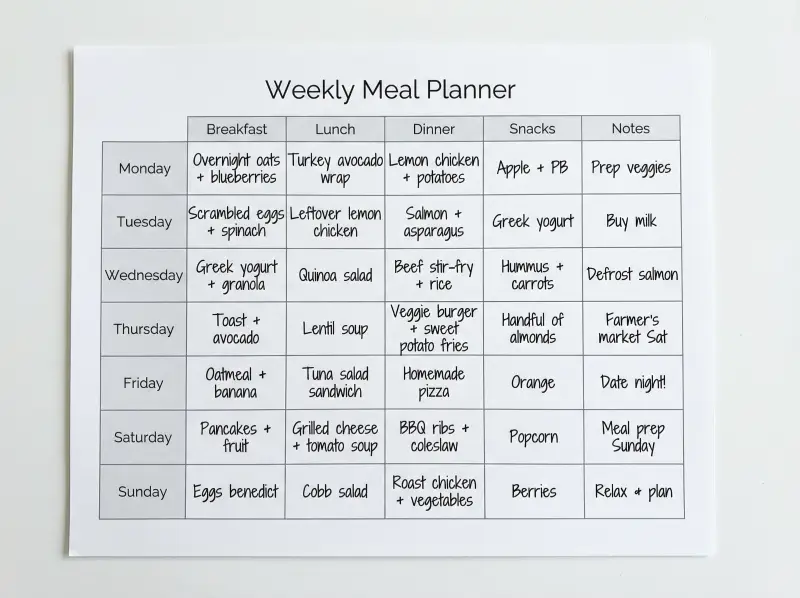
This printable weekly meal planner gives you a single page to map out breakfast, lunch, dinner, and snacks for Monday through Sunday. There's a notes column on the right for grocery reminders or leftover plans. Print it on U.S. Letter paper, stick it on your fridge or inside a binder, and plan your entire week in under 10 minutes. It works for any diet, household size, or cooking skill level.
Preview & Download
Print Settings
- Paper: U.S. Letter (8.5" × 11")
- Orientation: landscape
- Scale: 100%
- Margins: Default (0.5")
- 💡 Landscape orientation fits all columns without squeezing. Laminate for weekly reuse with a dry-erase marker.
What’s on this weekly meal planner
Each section of this planner is designed for fast, practical use — not elaborate journaling. Here’s a walkthrough of every field so you know exactly how to fill it out.
The planner uses a landscape layout with days running down the left side and meal types across the top. This gives each cell enough room to write a real meal description (not just “chicken”).
How to use this planner — 3 real scenarios
The best way to understand this planner is to see it in action. Here are three completely different ways real people use the exact same template.
Scenario 1: Sunday-evening planning for a working couple
You and your partner sit down after dinner on Sunday with the fridge open. You pick 4 dinner recipes from your rotation, assign cooking nights (Mon and Wed for you, Tue and Thu for your partner, Friday is takeout night), and fill in the planner together. Leftover dinners automatically become the next day’s lunches. The whole process takes about 12 minutes, and you tape the finished planner to the fridge door where you’ll both see it every morning.
Scenario 2: College student batch-prepping on a tight budget
You have a mini fridge and access to a shared kitchen. Sunday afternoon, you plan 5 lunches around 3 affordable ingredients: chicken thighs, rice, and whatever vegetables are on sale that week. Breakfasts are overnight oats every day (cheap, no cooking required). The planner helps you avoid impulse grocery purchases that spoil before you use them. Your weekly food budget drops from $60 to $35.
Scenario 3: Parent planning around a picky eater
Your 6-year-old willingly eats about 8 foods. You use the planner to make sure at least one “safe food” appears at every dinner while introducing one new item per week alongside it. The Notes column tracks which new foods were attempted and how it went (“tried roasted cauliflower — not a hit” or “broccoli with cheese sauce — asked for seconds”). Over a month, you build a picture of what’s working.
Example fill-out
Here’s what a realistic Monday through Wednesday looks like on a filled-in planner. Notice the cross-references between days — that’s intentional meal prep thinking.
Monday:
- Breakfast: Overnight oats with blueberries (prepped Sunday)
- Lunch: Turkey & avocado wrap + apple (packed in the morning)
- Dinner: One-pan lemon chicken with roasted potatoes (~35 min cook time)
- Snacks: Greek yogurt, handful of almonds
- Notes: Use leftover chicken for Tuesday’s salad
Tuesday:
- Breakfast: Same oats
- Lunch: Chicken salad over mixed greens (Monday’s leftover chicken, shredded)
- Dinner: Black bean tacos with quick-pickled onions (20 min)
- Snacks: Carrots + hummus, banana
- Notes: Thaw salmon for Wednesday
Wednesday:
- Breakfast: Scrambled eggs + toast (quick stovetop cook)
- Lunch: Leftover tacos reassembled as a burrito bowl with rice
- Dinner: Sheet pan salmon + asparagus (25 min)
- Snacks: Trail mix, string cheese
- Notes: —
The key details: Tuesday’s lunch uses Monday’s leftover chicken. Wednesday’s lunch repurposes Tuesday’s taco filling. The Notes column flags the salmon thaw reminder a day in advance. This is the kind of forward thinking that makes meal prep work.
Common mistakes (and how to fix them)
-
Planning 7 completely unique dinners in your first week. Start with 4 recipes and plan leftovers for the other days. You’ll actually follow through instead of abandoning the plan by Thursday.
-
Skipping the snack column. Unplanned snacks are the biggest reason meal prep budgets blow up. A $1.50 yogurt from home beats a $4 vending machine granola bar every time.
-
Writing vague entries like “chicken.” Be specific: “lemon chicken thighs, roasted, serve with rice.” Vague plans lead to 6 PM decision fatigue and a pizza order.
-
Not checking the fridge before planning. Spend 2 minutes scanning shelves first — you probably already have half the ingredients for at least one meal. Our Pantry Inventory printable makes this step effortless.
-
Treating the planner as permanent. Cross things out, move meals around, draw arrows. A messy planner that you actually use is infinitely more useful than a pristine one sitting in a drawer.
Customization tips
Google Docs version: Open the template, click File → Make a copy. Add or remove columns by right-clicking the column header. Change the starting day from Monday to Sunday if that matches your shopping schedule. Bold your batch-cook days so they stand out visually.
Lamination for weekly reuse: Print the blank planner once, take it to a FedEx Office or Staples for $2–3 lamination, and use a dry-erase marker each week. Wipe clean on Sunday evening and start fresh. This is the most cost-effective approach if you use the same format every week. Use matte lamination for better marker grip.
Adding a grocery summary: As you fill in meals, jot down needed ingredients in the Notes column. After planning all 7 days, transfer those notes onto our Grocery List printable organized by store section. This two-step process takes about 15 minutes total and replaces the “stare at the fridge and wonder what to cook” routine entirely.
Printing Tips
- Print on U.S. Letter (8.5" × 11") in landscape orientation
- Scale: 100% (do not use "Fit to Page")
- Margins: Default (0.5")
- 💡 Landscape orientation fits all columns without squeezing. Laminate for weekly reuse with a dry-erase marker.
Available Variants
We've created specialized versions for specific needs:
- →High-Protein Weekly Meal Planner — Same layout with an added protein grams column and daily protein totals
- →Family-of-4 Weekly Meal Planner — Adjusted portion columns and a kid-friendly meal section
- →Vegetarian Weekly Meal Planner — Plant-based protein reminders and vegetarian meal categories
Next step in your meal prep workflow:
Related Templates You Might Need
Most people use 2–3 of these together:
- •
- •
- •
- •
Helpful Guides
- •
- •
Frequently Asked Questions
Can I use this planner for a family of 6?
Yes. The planner layout works for any household size. If you need to track individual preferences or portion sizes, use our Family of 4 variant which has an extra column, or switch to the Google Sheets version where you can add columns easily.
What if I eat out 2–3 times per week?
That's normal. Just write 'eating out' or 'restaurant' in those dinner slots. The planner helps you plan the meals you ARE cooking — it's not a commitment to cook every single night.
Should I plan breakfasts if I eat the same thing every day?
Write it once in Monday's Breakfast cell and draw a vertical arrow down through Sunday. Saves time while still documenting your plan. The important thing is knowing you have those ingredients stocked.
How do I handle leftovers in the planner?
Write 'Leftover [dish name]' in the lunch or dinner column for the next day. Use the Notes column to write 'use by Wed' so you don't forget. Planning leftovers intentionally is one of the biggest time-savers in meal prep.
Can I change the week to start on Sunday?
The PDF starts on Monday, but if you prefer Sunday, use the Google Docs version and edit the day labels. Or simply cross out 'Monday' on the printed version and write 'Sunday' — it works either way.
Is this planner good for weight loss or specific diets?
This planner works for any eating style because it tracks meals, not macros. If you need to track calories or macros, pair it with our Macros Tracker printable. For high-protein or keto-specific layouts, see our variant pages.
What paper should I print this on?
Standard U.S. Letter paper (8.5 × 11 inches) works perfectly. Use regular 20lb copy paper for weekly disposable use. If you want to laminate and reuse with a dry-erase marker, any weight works — just make sure to use a matte lamination for better marker grip.
Can I use this digitally on a tablet?
The PDF can be opened in apps like GoodNotes, Notability, or any PDF reader on a tablet. However, if you want a truly digital experience with typing and formulas, our Google Sheets version is a better fit.