Freezer Inventory Printable
One-Minute Summary
This freezer inventory printable lets you track what's in your freezer—frozen meals, proteins, vegetables, fruits, and prepped components. Categories match typical freezer organization. List items and quantities; add dates when you freeze. The result: no more mystery packages, no more freezer burn surprises, and meal planning that uses what you've already prepped. Print on U.S. Letter paper. Update when you meal prep and when you shop for frozen items.
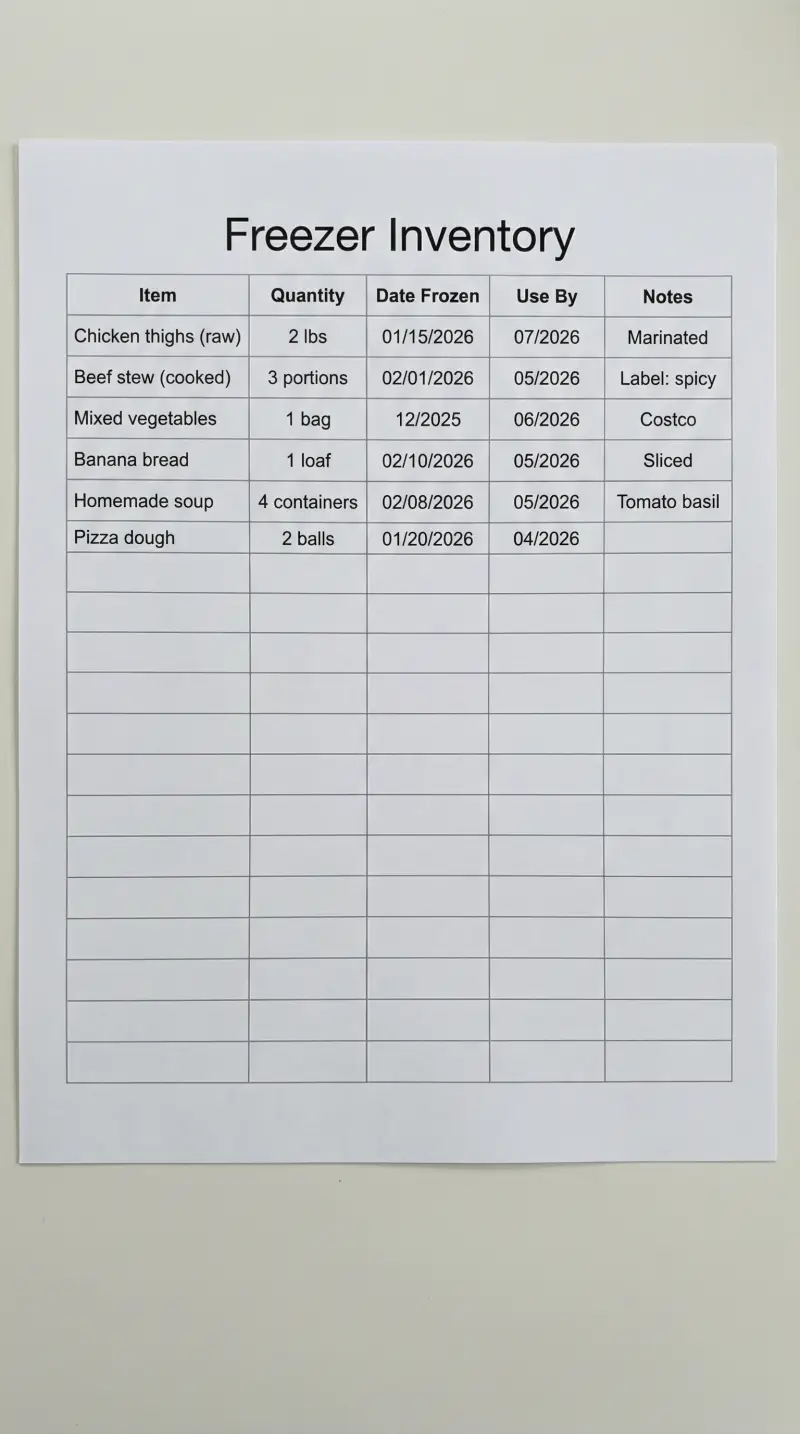
Preview & Download
Print Settings
- Paper: U.S. Letter (8.5" × 11")
- Orientation: portrait
- Scale: 100%
- Margins: Default (0.5")
What’s on this freezer inventory
This is not a generic “freezer checklist.” It’s a tracker for what’s actually in your freezer—prepped meals, proteins, vegetables, fruits, and other items. Categories match how most people organize freezer space. You list items, quantities, and dates. Update when you freeze and when you use.
The prepped meals section is for batch-cooked containers and leftovers. Date them—“chicken stir-fry 2/10”—so you use oldest first. The proteins section covers raw and cooked meat; note quantity and freeze date. The vegetables and fruits section tracks frozen produce for stir-fries and smoothies. The “other” section catches bread, dough, and prepared items that often get forgotten. The key: date everything. Freezer quality degrades over time; dates let you prioritize.
How to use this inventory — 2 real scenarios
Scenario 1: Meal prepper with a stocked freezer
You batch-cook every Sunday and freeze 2–3 extra portions. Without an inventory, you forget what’s in there. You buy more chicken and then find 3 frozen containers of chicken curry. The freezer inventory lists each prepped item and date. You see “chicken curry 2/1” and plan it for dinner this week before adding new meals. The freezer becomes a rotating stock instead of a black hole. Pair with our Meal Prep Checklist to add new items to the list when you prep.
Scenario 2: Family using freezer for convenience and sales
You buy family packs of chicken when they’re on sale and freeze portions. You stock frozen vegetables for busy nights. The inventory tracks what you have—“4 chicken breasts,” “2 bags broccoli”—so you plan meals from the freezer before buying fresh. You reduce food waste and capitalize on bulk purchases. The list lives on the freezer door or in your meal-planning binder. Check it before every Weekly Meal Planner session.
Example fill-out
A realistic freezer for a household that meal preps:
Prepped meals: Chicken stir-fry (2) — 2/10 · Turkey chili (1) — 2/8 · Beef stew (2) — 1/25
Proteins: Chicken thighs 2 lbs — 2/1 · Ground turkey 1 lb — 2/5 · Salmon fillets (2) — 1/20
Vegetables & fruits: Mixed veg (2 bags) · Broccoli (1) · Blueberries (1) · Spinach (1)
Other: Bread (1 loaf) · Pizza dough (1)
Dates on prepped meals and proteins help you rotate. Use oldest first. Update when you pull something—cross it off or deduct.
Common mistakes (and how to fix them)
-
Not dating items when you freeze. You’ll find a package and have no idea if it’s 2 weeks or 6 months old. Write the date on the package and the list. Use oldest first. A Sharpie and 2 seconds solve this.
-
Forgetting to update when you use something. You pull a meal for dinner—update the list. Without that habit, the inventory becomes fiction. Cross off or deduct quantity as you use. Make it part of the dinner routine.
-
Treating the freezer as infinite storage. Quality degrades over time. Raw chicken: 9–12 months. Cooked meals: 2–3 months. Vegetables: 8–12 months. Use the inventory to prioritize what to eat first. Don’t let good food become freezer-burned waste.
-
Not organizing the freezer to match the list. If your list says “bottom shelf: proteins” but your freezer is chaotic, you’ll lose items. Organize by category when you can—then the list matches reality. At minimum, keep like with like.
Customization tips
Use a Sharpie and masking tape for dates: Write the freeze date on every package. “2/15” or “Chicken 2/15” takes 2 seconds. Your future self will thank you when deciding what to thaw. Do it at the moment of freezing.
Update when you meal prep: Add new items to the list the same day you freeze them. Same when you pull something—cross it off. The inventory only works if it’s current. Build it into your prep routine so it becomes automatic.
Pair with meal planning: Before planning the week, check the freezer inventory. What needs to be used? Plan those first. Then add fresh meals. The freezer becomes the first source of dinner ideas—and reduces grocery trips.
Printing Tips
- Print on U.S. Letter (8.5" × 11") in portrait orientation
- Scale: 100% (do not use "Fit to Page")
- Margins: Default (0.5")
Next step in your meal prep workflow:
Related Templates You Might Need
Most people use 2–3 of these together:
- •
- •
- •
Helpful Guides
- •
- •
Frequently Asked Questions
How long do frozen items last?
Raw chicken/beef: 9–12 months. Cooked meals: 2–3 months. Vegetables: 8–12 months. Bread: 2–3 months. Use dates to prioritize—eat oldest first. When in doubt, smell and look when thawed.
Should I include freezer door items?
Yes. The door fluctuates in temperature—items there may not last as long. Note 'door' if you want to prioritize those. But for simplicity, list everything. Door items get used first by default since they're accessible.
How do I date items without defrosting?
Write the date on the package before freezing—use a Sharpie on the bag or masking tape. Or label containers when you pack them. Date at the moment of freezing, not when you inventory.
Can I use this with the Pantry Inventory?
Yes. Pantry = shelf-stable. Freezer = frozen. Use both for a complete picture. Before meal planning, scan pantry and freezer—then build your grocery list for what's missing. They complement each other.
What if my freezer is tiny?
The list is even more useful. Limited space means every item matters. Know what you have so you don't overbuy and have to cram. A small freezer benefits from rotation and intentional stocking.