Calorie Tracker Printable
One-Minute Summary
This calorie tracker printable gives you a simple daily log to record meals and calorie counts. Each meal—breakfast, lunch, dinner, snacks—has space for what you ate and the calories. A daily total row lets you compare to your target. Print on U.S. Letter paper, track for 1–2 weeks to build awareness, and adjust. No app required. Works for weight loss, maintenance, or understanding where your calories go.
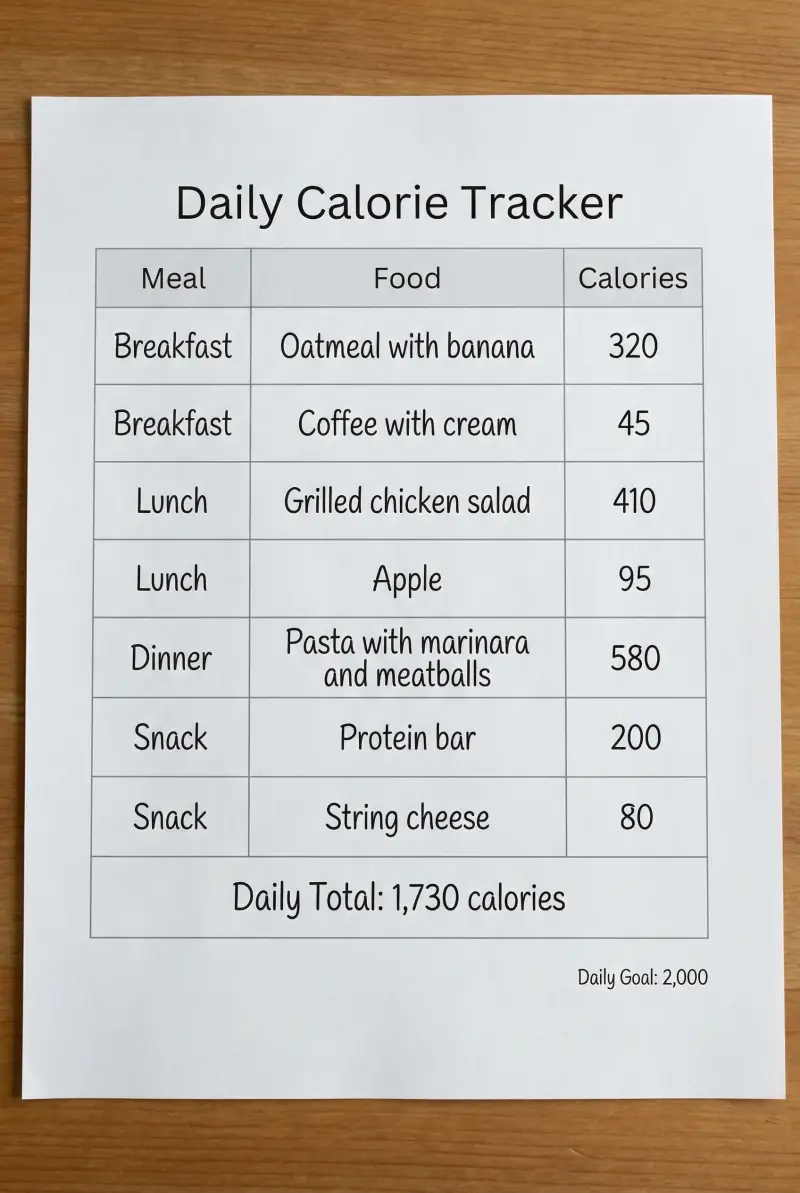
Preview & Download
Print Settings
- Paper: U.S. Letter (8.5" × 11")
- Orientation: portrait
- Scale: 100%
- Margins: Default (0.5")
What’s on this calorie tracker
This tracker uses a simple daily grid: one row per meal (breakfast, lunch, dinner, snacks) with space for what you ate and the calorie count. A daily total row at the bottom shows your sum. You compare that to your target and adjust the next day.
The food and portion column is critical. “1 cup cooked rice” is more accurate than “rice.” Portion size is the biggest variable in calorie tracking—a “handful” of nuts can be 100 or 300 calories. Be specific when you can. The calories column is where you write the number—from a label, an app, or a quick Google search. Round to the nearest 50; precision beyond that rarely changes outcomes. The daily total is your checkpoint. No guessing whether you’re over or under—the math tells you.
How to use this tracker — 3 real scenarios
Scenario 1: Weight loss without an app
You want to lose 1 lb per week—a 500-calorie daily deficit. Your target is 1,500 calories. You track on paper for 2 weeks. You discover your afternoon snacks and evening wine add 400 calories you hadn’t counted. You cut the snacks, keep the wine once a week, and hit your target. The printable keeps you off your phone at meals—no scrolling through an app. You write, you add, you adjust. Simple. Pair with our Weekly Meal Planner to plan lower-calorie meals in advance.
Scenario 2: Reverse dieting or maintenance after a cut
You’ve been in a deficit and want to find your maintenance calories. Track for 2–3 weeks while eating intuitively. Your daily totals range from 1,800 to 2,200. Average: 2,000. That’s your maintenance. You stop tracking and eat around that. The printable gives you data without committing to lifelong logging. Useful for anyone coming off a diet who wants to avoid rebound gain.
Scenario 3: Identifying calorie-heavy meals or times of day
You’re not trying to lose weight—you’re curious why you feel sluggish or why the scale won’t budge. Track for a week. Lunch is 800 calories (that burrito bowl), dinner is 600, but snacks from 3–6 PM add another 500. You had no idea. The tracker reveals the pattern. Swap the burrito for a salad or move some calories from snacks to meals. Data-driven, not guesswork.
Example fill-out
A realistic day for someone targeting 1,800 calories:
Breakfast: Overnight oats (1 cup oats, 1 cup milk, ½ cup berries) — 380 cal
Lunch: Chicken salad wrap + apple — 520 cal
Dinner: Grilled salmon (5 oz), rice (1 cup), broccoli — 580 cal
Snacks: Greek yogurt (1 cup) — 130 cal | Handful almonds — 170 cal
Daily total: 1,780 cal — Right at target. Tomorrow adjust if you’re hungry or overly full.
Common mistakes (and how to fix them)
-
Underestimating portions. A “medium” bowl of pasta can be 400 or 800 calories. Use measuring cups or a scale for 1–2 weeks. “1 cup” and “2 oz” are more accurate than “a helping.” Calibrate your eyes, then estimate.
-
Forgetting drinks. Coffee with cream: 50 cal. Latte: 200. Beer: 150. Juice: 120. Drinks add 300–500 calories without triggering the same fullness as food. Log them in the snacks row or add a drinks section.
-
Quitting after one bad day. You ate 2,500 calories on Saturday. So what? One day doesn’t define the week. Track it, note it, move on. Consistency over perfection. The tracker is a tool, not a moral judge.
-
Tracking only when “good.” If you only log days you eat well, your data is useless. Log the pizza, the birthday cake, the everything. The tracker is a mirror, not a judge. You need the full picture to make real changes.
Customization tips
Write your target at the top: “Goal: 1,800 cal” or “Maintenance: 2,200 cal.” Then compare your daily total. Some people add a simple +/- row: “Over by 150” or “Under by 80.” Quick visual feedback.
Bundle with macros if you want both: Use our Macros Tracker for protein/carbs/fat and this for total calories. Or use this alone—calories are the main lever for weight change. Macros matter for body composition; calories matter for weight.
One page per week: Print 7 copies or use a weekly layout. Seeing a week at a glance helps you spot patterns—e.g., weekends are +500 cal consistently. Adjust meal prep or weekend plans accordingly.
Printing Tips
- Print on U.S. Letter (8.5" × 11") in portrait orientation
- Scale: 100% (do not use "Fit to Page")
- Margins: Default (0.5")
Next step in your meal prep workflow:
Know your calories — now plan and prep with our Meal Prep Checklist →
Related Templates You Might Need
Most people use 2–3 of these together:
- •
- •
- •
Helpful Guides
- •
- •
Frequently Asked Questions
How do I find my calorie target?
Use an online TDEE (Total Daily Energy Expenditure) calculator. Enter age, weight, height, activity level. For weight loss, subtract 250–500 cal for 0.5–1 lb/week loss. For maintenance, use the TDEE number as-is.
Do I need to be exact?
Within 100–200 calories is fine. Weigh/measure for 1–2 weeks to calibrate; then estimates work. Perfectionism leads to burnout. 80% accuracy still gives useful data.
What about restaurant meals?
Estimate. Chain restaurants often publish nutrition info—use it. For independent places, search 'similar dish calories' or estimate by components. A burger with fries is roughly 800–1,200. Close enough.
Should I track on rest days?
Yes. Your calorie needs don't drop dramatically on rest days—maybe 100–200 less. Track so you can see the full picture. Skipping days creates blind spots.
Is this the same as a macros tracker?
No. This tracker focuses on total calories only. Our Macros Tracker breaks down protein, carbs, and fat. Use this for simplicity; use the macros tracker if you care about macro distribution (e.g., high protein for muscle building).