Budget Meal Planner Printable
One-Minute Summary
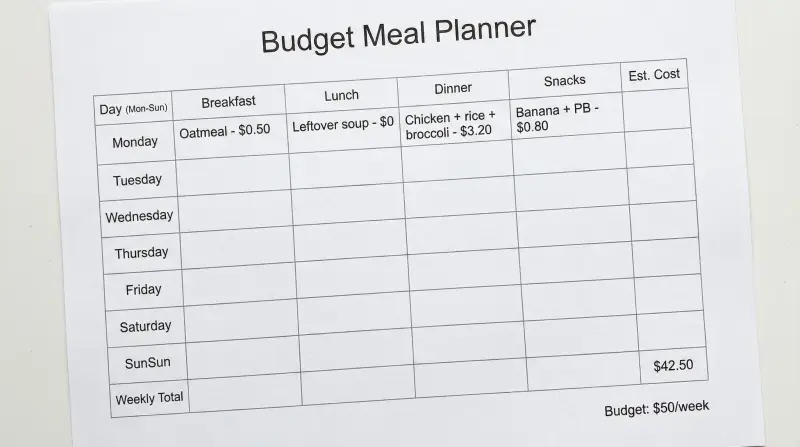
This budget meal planner printable gives you a weekly meal grid with an added cost column. Plan breakfast, lunch, and dinner for each day—and write the estimated or actual cost next to each meal. See where your food dollars go. Identify expensive nights and swap in budget options. Print on U.S. Letter paper. Works for anyone who wants to eat well without blowing the grocery budget. Pair with our Grocery List for a complete cost-conscious system.
Preview & Download
Print Settings
- Paper: U.S. Letter (8.5" × 11")
- Orientation: landscape
- Scale: 100%
- Margins: Default (0.5")
What’s on this budget meal planner
This planner uses the same weekly meal grid as our standard Weekly Meal Planner—days down the left, breakfast/lunch/dinner across the top—plus a cost column. You plan meals and assign an estimated cost to each (or each day). A weekly total row at the bottom shows whether you’re on budget.
The day rows and meal columns work like any meal planner: write real meals, not placeholders. The cost column is what makes this a budget tool. “$3” for a batch-cooked lunch, “$8” for salmon dinner. You see where money goes before you spend it. The weekly total keeps you accountable. If you’re over your target, you swap—expensive dinner for a beans-and-rice night. The planner makes tradeoffs visible.
How to use this planner — 3 real scenarios
Scenario 1: Family of 4 on a $150 weekly food budget
You have $150 for the week. Plan 7 dinners—2 with salmon ($12 each), 2 with chicken ($6 each), 2 with beans/rice ($3 each), 1 leftovers. Lunch is mostly batch-cooked ($2–3 per serving). Breakfast is oats and eggs ($1–2). Add costs as you plan. Total: $142. You’re under. The cost column forces you to think before you write—“can we afford salmon twice?” Maybe you do salmon once and add a second beans night. The planner makes the tradeoffs explicit. Pair with our Grocery List to execute the plan.
Scenario 2: College student stretching $40 per week
You have $40 for food. The budget planner shows you exactly where it goes. Overnight oats every morning: $5 for the week. Batch-cooked chicken and rice for lunch: $15. Dinners: pasta, beans, eggs, one treat night. You hit $38. The cost column prevents the “$2 here, $3 there” death by a thousand small purchases. You see the full picture and make choices before you shop. Plan first, buy second.
Scenario 3: Couple reducing takeout and tracking savings
You used to spend $80/week on takeout alone. You commit to 5 home-cooked dinners. Plan them with costs: $6, $5, $7, $4, $8—$30 total for 5 dinners. You’re saving $50. The budget planner documents the swap. Put the savings in a jar or transfer to savings. The visible comparison—$80 takeout vs. $30 home cooking—motivates you to keep going.
Example fill-out
A realistic week for two people targeting $60:
Monday: Breakfast: Oatmeal — $1 | Lunch: Chicken bowl (batch) — $2.50 | Dinner: Black bean tacos — $4. Day total: $7.50.
Tuesday: Breakfast: Eggs + toast — $1.50 | Lunch: Leftover tacos — $0 | Dinner: Pasta with vegetables — $3. Day total: $4.50.
Wednesday: Breakfast: Oatmeal — $1 | Lunch: Chicken bowl — $2.50 | Dinner: Chicken stir-fry — $6. Day total: $9.50.
Thursday–Sunday: Similar pattern—batch lunches, mix of budget and moderate dinners. Weekly total: ~$55. Under $60 target. Adjust next week if needed.
Common mistakes (and how to fix them)
-
Not estimating costs before you shop. If you plan first and add costs later, you’ll be surprised at checkout. Estimate as you plan—use past receipts or online prices. Rough is fine; zero is useless. Build the habit.
-
Forgetting snacks and beverages. A $2 bag of chips here, a $4 latte there—they add up. Include a snacks/beverages row or add 10–15% to your total. Hidden costs kill budgets. Track them or build in a buffer.
-
Planning expensive meals without cheaper backups. Salmon and steak every night won’t fit most budgets. Plan 2–3 “budget” meals per week—beans, eggs, pasta—and fill the rest with moderate-cost proteins. Variety and cost can coexist.
-
Ignoring leftovers in the cost math. Leftover dinner as next-day lunch costs $0. Plan leftovers intentionally. They’re the biggest budget multiplier—one cook, two meals. Use the Notes column to flag “leftovers → lunch.”
Customization tips
Use price-per-serving for batch cooking: If you make a big pot of chili for $12 and get 6 servings, that’s $2 per serving. Write that in the cost column. Batch cooking only saves money if you count it correctly. Do the math once, reuse the number.
Add a “swap” column: When you’re over budget, note cheaper alternatives—“Salmon → chicken” or “Steak → beans.” The planner becomes a decision tool, not just a record. See the swap before you shop.
Pair with the Grocery List: Transfer planned meals to the Grocery List. Write estimated prices next to items. Tally before you shop. The Budget Meal Planner drives the plan; the Grocery List executes it with real numbers. They’re designed to work together.
Printing Tips
- Print on U.S. Letter (8.5" × 11") in landscape orientation
- Scale: 100% (do not use "Fit to Page")
- Margins: Default (0.5")
Next step in your meal prep workflow:
Related Templates You Might Need
Most people use 2–3 of these together:
- •
- •
- •
Helpful Guides
- •
- •
Frequently Asked Questions
How do I know what things cost?
Use your last grocery receipt, or check store websites/prices online. Rough estimates are fine—$3 for a chicken breast, $1 for rice, $2 for vegetables. You'll get better with practice. The point is to have a number, not a perfect number.
Should I track actual or estimated cost?
Estimated when planning (so you stay within budget before shopping). Actual after shopping if you want to improve estimates. For most people, estimated is enough. Update as you learn your store's prices.
Does this include groceries or just meals?
Meals—what you'll eat. Your grocery bill will include non-meal items (cleaning, toiletries). For food-only tracking, sum the meal costs. For full grocery tracking, use the total receipt and compare to your target. The planner focuses on meal costs because those are controllable.
What's a realistic budget for 2 people?
U.S. averages: $150–250/week for two, depending on location and diet. Budget-conscious: $80–120. The planner helps you hit whatever target you set. Start with your current spending and reduce by 10–20% as a goal.
Can I use this with the Weekly Meal Planner?
Yes. The Budget Meal Planner has the same meal grid plus the cost column. Use it instead of the standard Weekly Planner when cost matters. Or use the Weekly Planner for planning and add costs in the margin—works either way.