Cleaning Schedule Printable
One-Minute Summary
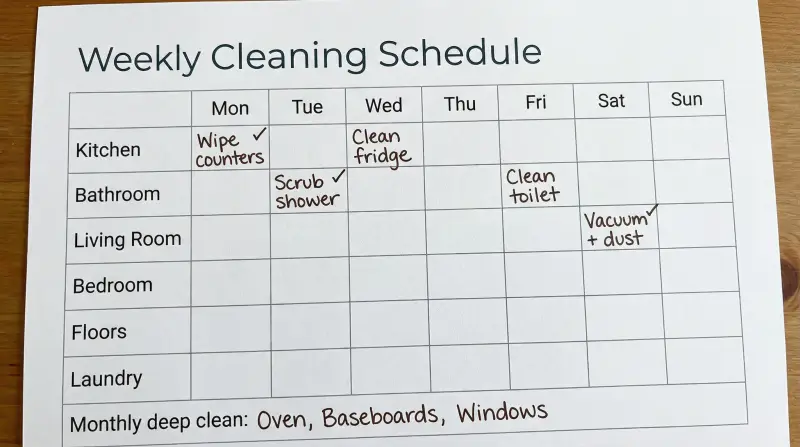
This printable cleaning schedule gives you a single-page grid to map out daily, weekly, and monthly chores. Assign tasks by day or week — bathroom scrub on Saturdays, laundry on Sundays, deep clean the kitchen monthly. Print on U.S. Letter paper, post it on the fridge or inside a household binder, and keep your home on track without overwhelming yourself. Works for any household size or schedule.
Preview & Download
Print Settings
- Paper: U.S. Letter (8.5" × 11")
- Orientation: portrait
- Scale: 100%
- Margins: Default (0.5")
- 💡 Print portrait. Post on fridge or inside a household binder for daily visibility.
What’s on this cleaning schedule
This printable gives you a single-page grid to organize daily, weekly, and monthly chores. Each section is designed to keep your home maintainable without overwhelming your schedule.
The daily tasks row covers quick 5–15 minute maintenance: make beds, wipe counters, quick tidy. These prevent buildup. The weekly grid assigns 2–3 deeper tasks per day — bathroom scrub one day, kitchen another, floors on another. The monthly section covers less frequent jobs like window washing, fridge coil cleaning, and decluttering one room per month.
How to use this schedule — 3 real scenarios
Scenario 1: Working couple with weekend-only cleaning time
You and your partner work full-time. Weekday evenings get 10 minutes of daily tidying — make beds, wipe counters, quick sweep. Saturday morning is reserved for bathroom and kitchen deep clean. Sunday handles laundry, vacuuming, and one monthly task (this week: clean the microwave). The schedule fits into 2–3 hours total per week. You both know what to expect, and the house stays presentable without marathon cleaning sessions.
Scenario 2: Stay-at-home parent with kids in school
Daily tasks happen during school hours when the house is quiet. One room gets deep-cleaned each weekday — Monday bathrooms, Tuesday bedrooms, Wednesday kitchen, Thursday living areas, Friday floors. Monthly tasks rotate: week one is windows, week two is fridge interior, week three is declutter one room, week four is air filter change. The schedule prevents the “whole house is a disaster” overwhelm and builds a sustainable rhythm.
Scenario 3: Apartment dweller with limited storage
Focus on high-impact weekly tasks: bathroom scrub, kitchen deep clean, floors. Monthly tasks are minimal — smaller spaces need less. The schedule fits on one page, stays visible on the fridge, and takes about 90 minutes total per week. No elaborate system, just consistent maintenance.
Example fill-out
Daily: Make beds, wipe kitchen counters, 10-min tidy, take out trash
Weekly: Monday — Vacuum living areas. Tuesday — Bathroom scrub. Wednesday — Kitchen deep clean. Thursday — Dust surfaces, change sheets. Friday — Floors. Saturday — Laundry, grocery run. Sunday — One monthly task.
Monthly rotation: Week 1: Windows. Week 2: Fridge coils. Week 3: Declutter one room. Week 4: Change air filters.
The key is assigning tasks so no single day feels overwhelming. Spread the work and stick to the routine.
Common mistakes (and how to fix them)
-
Scheduling every room every week. Most homes don’t need that intensity. Rotate zones — bathroom one week, bedrooms the next. You’ll maintain without exhausting yourself.
-
Skipping the daily quick tasks. Those 5–10 minutes prevent weekend marathons. A wiped counter daily beats scrubbing dried-on spills for an hour.
-
Treating the schedule as rigid. Miss Tuesday? Do it Wednesday. Life happens. A flexible schedule you follow beats a perfect one you abandon.
-
Forgetting seasonal tasks. Add HVAC filter changes quarterly, gutter cleaning in fall. Write them in the Notes section so they don’t slip through the cracks.
-
Not posting it visibly. A schedule in a drawer doesn’t work. Put it on the fridge or a bulletin board. Visibility drives accountability.
Customization tips
Lamination for reuse: Print once, laminate at FedEx or Staples for $2–3, and use a dry-erase marker each week. Wipe and reassign as your routine evolves.
Room-by-room alternative: If a grid feels abstract, pair this with our Deep Cleaning Checklist for room-by-room checklists. Some people prefer checking off “master bathroom” as a unit.
Shared household: Write initials next to tasks or use different colors for each person. A visible schedule reduces “I thought you were doing it” conflicts.
Printing Tips
- Print on U.S. Letter (8.5" × 11") in portrait orientation
- Scale: 100% (do not use "Fit to Page")
- Margins: Default (0.5")
- 💡 Print portrait. Post on fridge or inside a household binder for daily visibility.
Next step in your meal prep workflow:
Related Templates You Might Need
Most people use 2–3 of these together:
- •
- •
- •
Helpful Guides
- •
Frequently Asked Questions
How much time should I budget for cleaning each week?
Most households need 2–4 hours total: 30–60 minutes of daily quick tasks spread across the week, plus 1–2 hours for weekly deep cleaning. Monthly tasks add another 1–2 hours per month.
What if I fall behind on the schedule?
Prioritize: daily tasks first, then bathroom and kitchen. Floors and dusting can wait a day. Don't try to 'catch up' by doing everything at once — that leads to burnout.
Should I include laundry in the cleaning schedule?
Yes. Laundry is part of household maintenance. Assign a specific day (e.g., Sunday) so it doesn't pile up. Include folding and putting away in the same block.
How do I adapt this for a larger home?
Split zones across days: Monday = upstairs bathrooms, Tuesday = downstairs. Or assign rooms to different weeks. The grid format scales — just add rows or use multiple pages.
Can I use this with a roommate or partner?
Absolutely. Write initials next to tasks or use different color pens. A shared schedule on the fridge reduces confusion about who does what and when.
What if I have kids — how do I get them to help?
Assign age-appropriate tasks: make beds, put toys away, wipe table. Add a 'kid tasks' row. Consistency matters more than perfection — even a 5-year-old can learn to straighten a room.